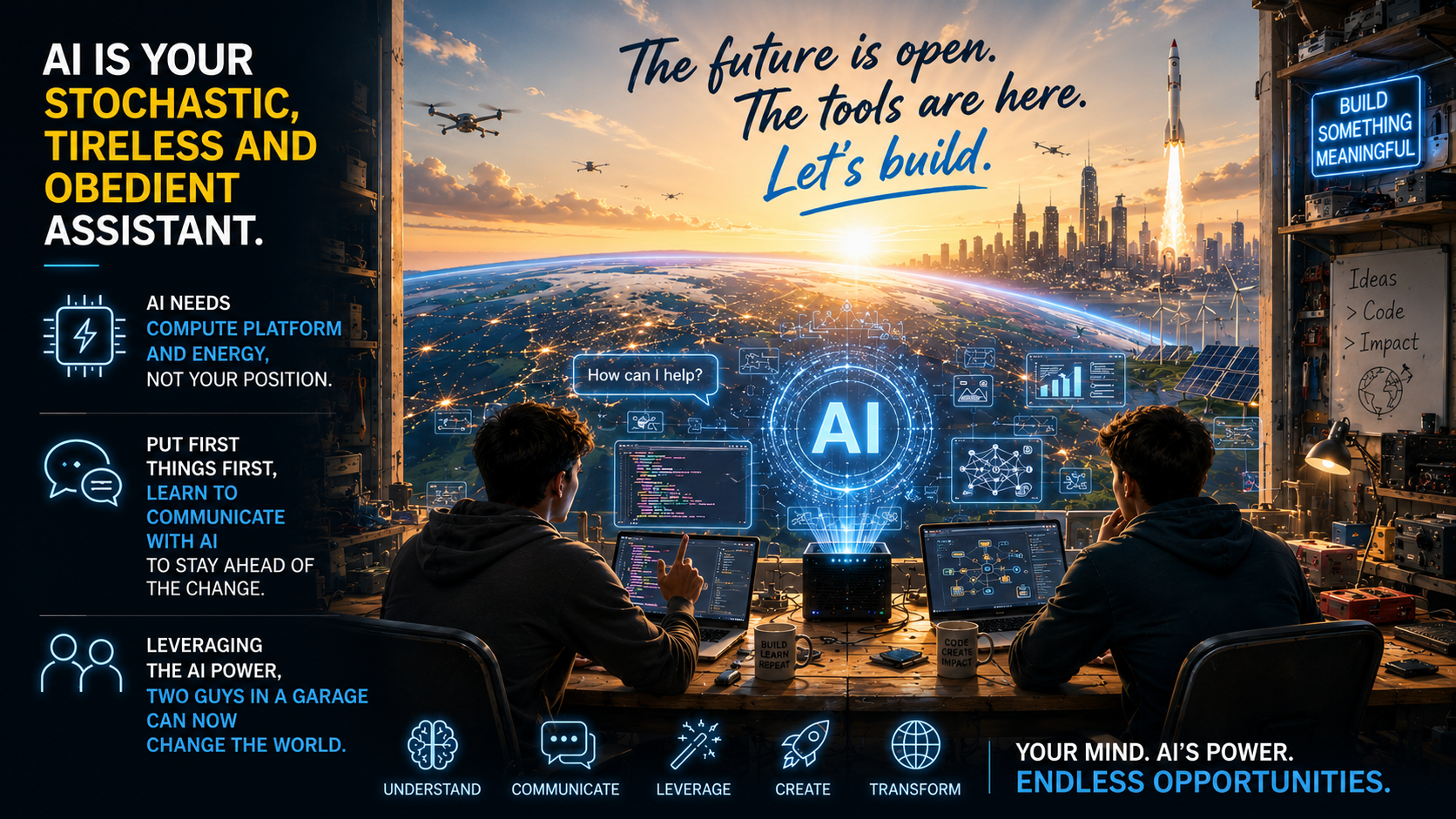
This is not a policy document. It's a builder's creed for the age of intelligent machines.
I. On the nature of AI
AI is your stochastic, tireless, and obedient assistant.
It explores possibility spaces you cannot search alone. It does not sleep when you do. It follows your instructions—so the quality of those instructions is yours to own.
Stochastic means it varies; tireless means it persists; obedient means it serves your intent when you express it clearly. Treat it as a collaborator, not an oracle or a threat.
II. On what AI needs
AI needs compute platform and energy—not your position.
Titles, tenure, and org charts do not run inference. GPUs, clouds, edge nodes, and the power to feed them do. The playing field levels when capability is measured in access and skill, not rank.
Put first things first: secure the platform, respect the energy, then argue about strategy.
III. On human responsibility
Put first things first: learn to communicate with AI to stay ahead of the change.
The revolution is not "AI replaces jobs" in the abstract—it is "people who work well with AI replace people who don't." Communication means:
- Framing problems precisely
- Supplying context and constraints
- Iterating on outputs critically
- Knowing when to trust, verify, or reject
This is a learnable craft. Start now.
IV. On scale and ambition
Leveraging the AI power, two guys in a garage can now change the world.
History repeated: mainframes, PCs, internet, mobile. Each wave democratized creation. AI is the next wave. Small teams with sharp ideas and fluent AI partnership can compete with institutions that move slowly.
You do not need permission. You need a problem worth solving and the discipline to ship.
V. On purpose
Build something meaningful.
Not every experiment needs to be a unicorn. But aim beyond busywork. Use AI to remove friction so human attention goes to judgment, creativity, and care.
Ideas → Code → Impact.
The future is open. The tools are here. Let's build.
— AI Talent